

Myths about low back pain: Is complete rest really a good thing (Evidence-based guide)?
Published on:
Last modified:
The low back pain (low back pain) is one of the most frequent causes of medical consultation and sick leave. When faced with an episode, many people wonder if the best thing to do is to complete bed rest. For years, “bed and patience” was recommended, but today we know that, in most cases, this is not the case, total rest does not accelerate the recovery and may worsen the evolution.
In this article we clarify the myth of rest, when it can be useful, what to do to improve and when to go to a pain unit. when to go to a Pain Unit.
Low back pain: Is complete rest a good idea? Myths and what to do | MIVI Health
Low back pain (low back pain): find out if complete rest helps, when it is recommended and what to do to relieve low back pain. Warning signs and treatment.
Low back pain or lumbago: what is it and why does it appear?
We call low back pain to pain located in the lower back. It can appear after an effort, by maintained postures, sedentary lifestyle, stress, lack of core strength, muscle overloads or age-related degeneration.
An important fact to understand management: most episodes of low back pain are non-specific. nonspecificwhich means that there is no identifiable serious cause (fracture, infection, tumor). Even so, the pain can be intense and very limiting.
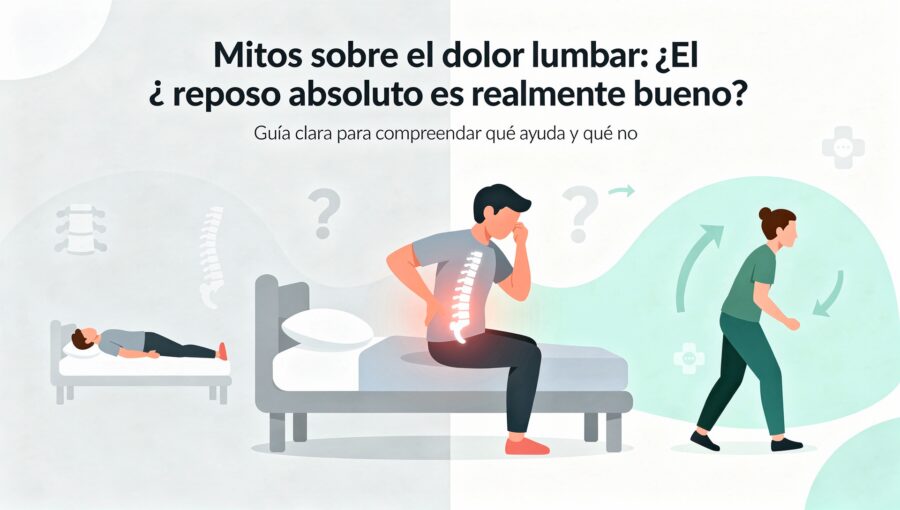
Myth 1: “If my back hurts, it is best not to move”.
It is a widespread idea: “if it hurts, it must be because it is damaged”. However, in the back, pain does not always equate to serious injury. And the complete bed rest (staying in bed or drastically reducing activity for days) often results:
- Stiffness and loss of mobility
- Muscle weakness (especially in the lower back, buttocks and abdomen)
- More sensitivity to pain when resuming activity
- More fear of movementwhich can perpetuate the problem
Conclusion: in the majority of acute low back pain, maintaining adapted activity is usually better than immobilization.
So… is absolute rest bad for low back pain?
In general terms: yes, if prolonged.
The recommended practice is usually:
✅ relative rest (rest without immobilization) if the pain is very intense.
✅ avoid staying in bed for long hours at a time
✅ return to movement as soon as possibleprogressively
In practice, this usually translates into something simple: continuing with daily life “at low intensity” and moving within tolerable limits (e.g., walking, frequent changes of posture, gentle mobility).
What to do in case of acute low back pain: useful recommendations
If you are in an episode of low back pain:
1) Keep active, but adjust the load
- Walking is usually one of the best options.
- Avoid sudden efforts and loads (for example, lifting weights without technique).
2) Alternate positions
Sitting or lying down for too long can increase stiffness. Changing posture frequently often helps.
3) Apply local heat if relieved.
Heat may decrease muscle tension in some cases.
4) Guided analgesia if necessary.
Always with medical criteria, pain control makes it easier to move and recover.
5) Nerve blocks, back joint blocks, or intradiscal procedures.
For a quick recovery to the usual tasks.
6) Initiate therapeutic exercise when peak pain subsides.
The objective is not to “crush”, but rather to recover mobility, strength and control to reduce relapses.
Myth 2: “If I have a herniated disc, I must rest”.
The lumbar disc herniation is a frequent finding in imaging tests and does not always cause pain. When symptoms are present, it is not only the MRI that determines the treatment, but also clinical examination and type of symptoms.
In many cases, even with hernia, the approach includes:
- pain control,
- guided movement,
- physiotherapy and progressive strengthening,
- and, if applicable, specific techniques.
Important: not all low back pain requires an entry MRI; it is indicated when there are clinical criteria or evolution that justifies it.
Warning signs of low back pain: when to go to the emergency room or preferential consultation
Consult with priority if any of these signs appear:
- Pain after major trauma
- Fever, chills or general malaise
- Severe nocturnal pain that does not improve with changes in posture
- Progressive loss of strength in one leg
- Sphincter disturbances or numbness in the perineal area (“saddle sided”)
- Pain that does not improve in 4-6 weeks or recurs frequently
When low back pain becomes chronic: an advanced approach from a Pain Unit
If low back pain lasts for more than 3 months, we speak of chronic low back pain. In these cases a structured approach is appropriate:
- Complete clinical and functional diagnosis
- Identification of mechanical, inflammatory, neuropathic or myofascial factors
- Combined plan: therapeutic exercise + education + pain control
- Interventional techniques when indicated. Include nerve or joint blocks with local anesthetics/corticoids, Ozone, Platelet Rich Plasma (PRP), Laser, etc. (according to medical criteria).
- Follow-up to prevent relapses
Correct management has two objectives: to reduce pain y restore function (move, work, sleep better and recover quality of life).
Summary: Absolute repose yes or no?
- For most back pain: NO to prolonged absolute rest.
- Yes to a short relative rest if the pain is very intense, and to to get back on the move as soon as possible.
- If there are warning signs or no improvement, consult.
The key message is simple: the back is made to moveand in most cases proper movement is part of the treatment.
Pain Unit – MIVI Málaga | MIVI Salud