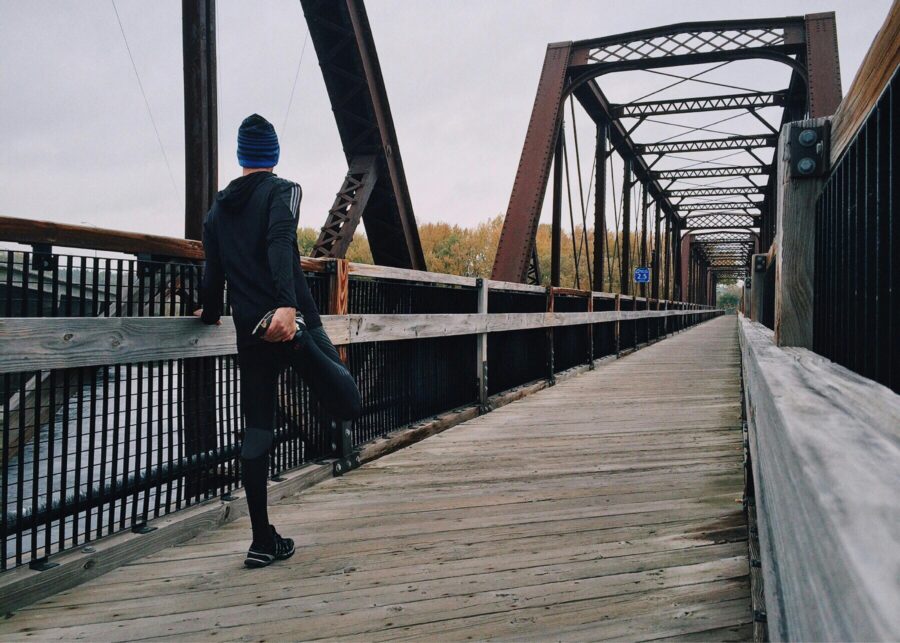

Basic warm-up to avoid injury during physical activity

Published on:
Last modified:
Warming up before practicing sports is essential and can help us prevent injuries. Going from being inactive (because we have just been working or resting for a long time), to putting our body to work at a higher physical level, increases the risk of muscle injuries.
For this reason, we should always perform a warm-up that involves, above all, the main area of the body that will support the workload during exercise. This does not mean that we should not warm up other parts of our body, as it is likely that they will also be involved in a secondary way.
Today we are going to propose some exercises that we can perform before our sports routine, adapting to our physical situation and our possibilities.
Of course, always before, we recommend consulting a health professional or a specialist in sports physical preparation, so that he/she can adjust each warm-up and subsequent physical activity to our needs.
How to avoid injuries by warming up correctly
There are some areas of our body that tend to get injured more easily, such as shoulders, knees, or back. Areas where there is joint movement, or that are responsible for holding more weight in our body, and that we have to take special care to avoid getting hurt or chronically overloaded.
Warming up will not prevent injuries, but it is certainly a step prior to any physical activity, and a way to minimize the risk. Next, we will see some recommended exercises to warm up several areas of our body:
Preheat shoulders
Let’s start with the shoulders, as they are a particularly sensitive area due to their wide range of motion. Performing gentle rotations is key to preparing the shoulder joint and avoiding common injuries such as tendonitis or impingement during physical exertion.
A good way to warm up the shoulders is precisely by working on their rotation so that the joint is prepared for the exercise. To do this, we separate the legs, extend the arms next to the trunk, and rotate them as if it were a propeller. We will do it in both directions: first forward, and then backward, for a few seconds.
Another way to warm up the shoulders is to make them rotate with the arms attached to the trunk. We have to do as if we were shrugging our shoulders, trying to make a circular motion, back and forth.
Preheat knees
The knees are another area that, if not well prepared for exercise, can be easily injured, even in more relaxed activities such as walking with greater or lesser intensity. The knees, in addition to allowing us to bend our legs, also support the weight of our body and the impact of certain actions, so it is also important to warm them up before starting our activity.
To warm up the knees, we can bring the legs together a little and bend them slightly, putting one hand on each knee. With our feet together, we turn with our knees to the left and right. We can also do alternating push-ups, first with one leg, then with the other, as if we were trying to reach the buttocks with the heel.
Preheat the hips
By performing circular movements with the pelvis, we are activating the flexors and the coxofemoral joint. This step is vital to prevent pelvic and hip pain, a frequent problem in athletes who do not properly prepare the loading zone before running or jumping.
Preheat wrists and ankles
The wrists and ankles are fragile points in our extremities, and they also allow for a great range of motion. It is easy to injure these areas, either through overuse or ligament injuries, especially in the ankles.
To warm up the wrists, we can join our hands by interlocking our fingers, and make circular movements as if we were drawing the infinity symbol (an 8 in horizontal position). For a few seconds we can do it in one direction, and then change.
To warm up the ankles, we can stretch the foot by touching the toe on the floor with the heel elevated, and rotate it in both directions. First one foot, and then switch to the other.
Preheating the back
We must not forget the mobility of the spine. A good warm-up of the dorsal area not only improves posture during exercise, but also helps to release accumulated tension in the middle back, avoiding contractures due to sudden movements.
Stretching the back will also help us to prevent injuries in one of the most important areas of our body, which tends to be injured by sudden actions without adequate preparation for physical exercise.
In Living without Pain, of the Aliaga Institute, we have previously talked about some stretches for the lumbar area, responsible for supporting most of our body weight.
Estos son algunos ejercicios sencillos que podréis realizar antes de empezar vuestra práctica deportiva, o simplemente si queréis desentumecer vuestro cuerpo tras varias horas de inactividad. Como hemos recordado antes, es importante acudir a un profesional que nos diga cuáles son las mejores opciones en función de nuestro estado físico actual.
Above all, we must be especially careful not to damage any area where we may have an injury. In that case, and if the injury in the back or in any of our joints lasts for several weeks, it would be best to go to a pain professional such as those at MIVI for a correct diagnosis and treatment.