

Adhesive Capsulitis (Frozen Shoulder)
What is
Frozen shoulder, also known and named as adhesive capsulitis or retractile capsulitis, is a pathology that affects the shoulder joint.
It could be defined as “freezing of the joint capsule “. Its main characteristic is pain and limitation of movement.
To understand this process we must know what the capsule is and what its function is.
WHAT IS THE JOINT CAPSULE?
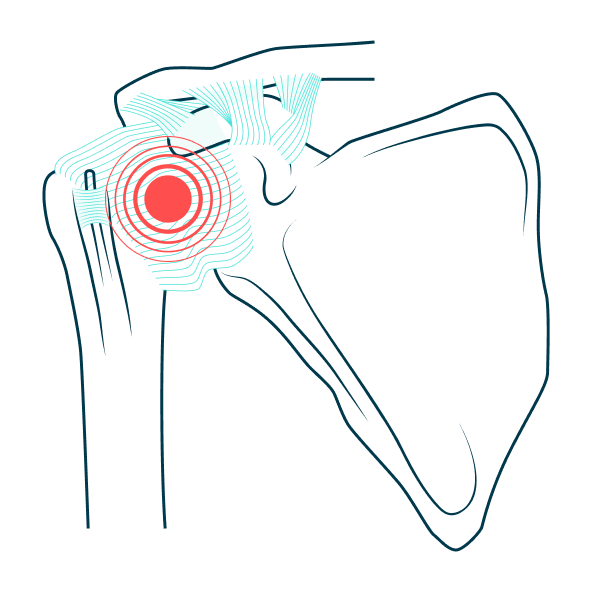
It is a fibrous structure that gives congruence to the glenohumeral joint (humerus-scapula/ shoulder blade). It has a very important role in the joint, if it were not for it, the humeral head (the ball of the shoulder, as many people know it) would come out of the joint very easily.
Another of its main functions, together with that of giving stability and firmness to the joint, is to send information to our Central Nervous System about the position of our arm.
It also helps to cushion possible trauma to the joint. It protects the bone components, thanks to its lubrication by means of synovial fluid (“jelly-like substance”).
In frozen shoulder or adhesive capsulitis, the capsule becomes inflamed and stiffens. Through these stiffnesses the shoulder “binds” to the joint reducing the possibility of movement.
Causes
The reasons for this are often not known exactly, although it is known that there are certain factors that favor it and among them are the following:
- The presence of diabetes mellitus.
- Thyroid gland problems such as hypothyroidism and hyperthyroidism.
- Parkinson’s disease.
- Prolonged immobilization of the shoulder joint.
Pathologies such as rotator cuff tendinitis that may trigger a decrease in shoulder mobility may contribute to the development of this pathology.
Dr. Neira from MIVI Sant Cugat tells us about it in this video: https://www.instagram.com/p/DE1yxpJIgLS/?hl=es

Symptoms
Symptoms appear gradually, usually in three stages:
- Freezing stage: in this stage the pain increases little by little while the range of motion decreases. The duration of this stage is very variable, ranging from 6 weeks to 9 months, and is the initial and most painful phase. The patient suffers pain mainly at night, in the anterior and lateral aspect of the shoulder, being able to radiate towards the arm. The duration of this phase is variable, it is usually around 2 months.
In this phase physiotherapy is very important. Aiming to reduce inflammation and avoid stiffness.
In some cases, it is necessary to work with our physicians to perform an echo-guided infiltration (corticosteroids). This will reduce inflammation and decrease pain. This will allow the physiotherapist to work better.
If it does not improve with this infiltration, a hydrodilatation(introduction of anesthesia and physiological saline at intra-articular pressure) will be assessed (by the doctor), to achieve a dilatation and increase of the space inside the joint, increasing significantly the mobility of the joint. It will always be necessary physiotherapy after this intervention.
- Freezing stage: in this stage it is characteristic that the patient presents less pain, however, stiffness is maintained, as well as functional disability. This stage lasts between 4 and 6 months, during which pain decreases and joint stiffness gains prominence, causing limitations in activities of daily living. The patient describes the impossibility to raise the arm, to make external rotations, and will even be very limited in daily gestures. The difficulty or impossibility of separating the arm from the body is the symptom that makes many patients seek help and put themselves in the hands of their physiotherapist or traumatologist of confidence.
Unfortunately, until the pathology reaches this stage, many patients endure the pain with oral medication and with the “hope” that it will disappear by itself, just as it appeared spontaneously. For this reason, we advise not to wait or endure pain for such a long time simply because you have not made any overexertion or have not suffered a fall, blow or trauma.
- Thawing stage: this is the recovery stage and it is characteristic that the movement improves thanks to the treatments. Complete recovery lasts from 6 months to 2 years.
These usually appear spontaneously. We can find some predisposing factors such assystemic diseases, hyperthyroidism or hypothyroidism, diabetes and cardiovascular diseases. The age range is usually between 40 and 55-60 years and more frequently affects the female sex.
Secondary capsulitis” usually appears after shoulder surgery, trauma or long periods of immobilization.
In frozen shoulder, what happens to the capsule is that it becomes inflamed and hardens. As a result, it becomes denser and consequently loses its capabilities.


Our customers say


Insurance companies
Ask your MIVI centre for information on the agreements with insurance companies.