Lumbar facet syndrome

What is

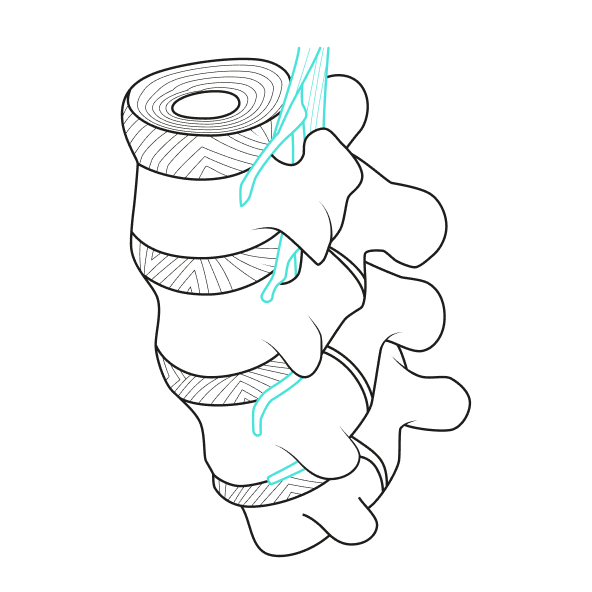
The facet joints are small joints located in the posterior part of the entire spine that play a fundamental role in the functions of stabilization and reinforcement of the spine. In addition to these functions, they facilitate and allow rotation and flexion-extension movements.

Over the years, overexertion, environmental or hereditary factors of each person cause the intervertebral disc that separates the vertebrae to wear so that the distance between the vertebrae decreases, this factor is very important because it directly affects the facet joints promoting wear so that they collide and become inflamed causing pain. If the alteration is not corrected, the joints will continue to wear out, producing what we know as facet syndrome in the lumbar area.
Causes

It is usually caused by degeneration of the facet joints of the lumbar region. This fact contributes to this fact:

  • Degeneration of the intervertebral disc: discoarthrosis, disc protrusion or disc herniation.
  • Trauma
  • Overweight
  • Antero listhesis or retrolisthesis

Symptoms

Symptoms appear when there is pain in the lumbar region due to wear and tear of the facet joints.

This pain has some peculiar characteristics that help to differentiate it from other types of low back pain:

  • It is located in the spine in what is called the paravertebral area.
  • It may radiate to the buttocks, groin and back of the thigh and increases with twisting and hyperextension movements.
  • It is accentuated by standing for long periods of time, causing a forward lean, as this produces pain relief by relieving pressure on the affected joints.


Approach protocol

Diagnosis and assessment

A correct medical evaluation will be necessary by means of a good anamnesis, physical examination and, if necessary, support of imaging tests. Focusing especially on detecting the factors that lead to the overload of these joints (in this phase the biomechanics, the podiatrist and the physical trainer will be essential) and assessing whether the injury is exclusively at a vertebral level or if there are more conditions in adjacent areas. In addition, it is not uncommon for this type of pain to overlap with episodes of sciatica-type pain that should be evaluated together. The multidisciplinary approach is essential for a comprehensive, personalized approach, focused on achieving prolonged pain relief depending on the phase in which it is found and may involve the collaboration of professionals in biomechanics, podiatry and physiotherapy.

Complementary tests

X-rays, CT or MRI scans are usually performed.

Treatment

Treatment will depend on the physician’s diagnosis and may be applied:

  • Drugs for pain relief
  • Physiotherapy:the combination of osteopathic manual technique treatments with invasive neuromodulation/electrolysis techniques associated with technologies such as Magnetolith, superinductive systems, MBST and therapeutic exercise.
  • Interventional treatments:
    • Facet blocks
    • Facet radiofrequency
    • Functional rehabilitation

Here begins your life without pain

Our customers say

toxic
Hace cerca de 20 años que me visito con el doctor Genaro Mañero y estoy muy contenta con sus visitas y revisiones. Es un excelente profesional y muy atento con sus pacientes.
Miguel Gómez López
Mu buen doctor el doctor madero
Jesus Arias
Me atienden de maravilla. Buenos profesionales.
Rufino Cortes
El doctor MORALES es un crack, nada mas tengo que elogios para el como persona y profesional. Llevo con unos 9 años con el y me estoy salvando de operarme.
Kelsang Gachog
elena casado gomez
Paula y Silvia buenisimas recepcionistas, super amables y atentas!! :)
Carlos Luzón
FRANCISCO DUCA Y SU EQUIPO SON LOS MEJORES QUE ME HAN TRATADO
Marc Guerrero
Muy buena experiencia, buen doctor
Janira Arnedo

Insurance companies

Ask your MIVI centre for information on the agreements with insurance companies.