
Wrist Arthrosis (Rizarthrosis)

What is

The
rhizarthrosis
also known as
osteoarthritis of the wrist
is a degenerative pathology that mainly affects the base of the thumb.
base of the thumb
. It is produced by the
progressive wear of the articular cartilage
in this area, which generates pain, stiffness and difficulty in performing movements involving the use of the hands.

The development of rhizarthrosis is usually slow and progressive.
slow and progressive
beginning with mild discomfort that intensifies over time, especially when performing everyday activities such as opening a jar, turning a key or writing. As the disease progresses, loss of mobility and functional limitation can significantly interfere with quality of life.

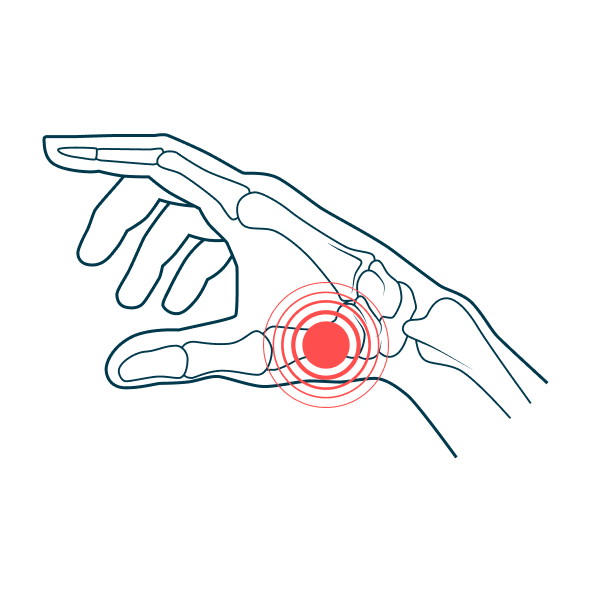
When we speak of rhizarthrosis, we refer specifically to osteoarthritis affecting the trapeziometacarpal joint.
trapeziometacarpal joint (between the trapezium and the first metacarpal).
(between the trapezium and the first metacarpal bone), although in more advanced cases the trapeziometacarpal joint may also be involved.
trapezioscaphoid joint can also be involved
.

This degeneration of articular cartilage cannot be cured, so the therapeutic approach is based on
slowing its progression
and
and providing optimal conditions to preserve the functionality of the hand for as long as possible.
functionality of the hand for as long as possible.
Causes

The main causes and risk factors for rhizarthrosis are:

    • Advanced age
    • Genetic background
    • Predisposition in women
    • Rheumatoid arthritis
    • Repetitive movements
    • Obesity
    • Sedentary lifestyle

Symptoms

The most common are continuous pain at the base of the thumb and loss of strength and/or difficulty in performing many of the activities of daily living (opening a bottle, writing, opening a door, cutting with scissors, holding a glass, tonging…). These symptoms may be accompanied by swelling, deformity and the presence of clicking or popping noises on movement. In more advanced stages, the shape of the hand will be affected, the thumb tends to close, making hand motricity even more difficult, and the pain may disappear or diminish. The condition may present with periods of increased pain (nocturnal and even at rest) that are more inflammatory (arthritis or synovitis).

  • Pain in the area that is no longer protected due to cartilage wear.
  • The crunching sounds that occur when the joint wears out.
  • The effusion that produces inflammation that is triggered in an unprotected joint.
  • The increase in size of the joint caused by the growth of bones that are no longer protected by cartilage collide.
  • Decreased mobility.


Approach protocol

Diagnosis and assessment

A correct medical evaluation will be necessary by means of a good anamnesis, physical examination and, if necessary, imaging tests. Focusing especially on identifying risk factors that may have influenced the development of the pathology.

Complementary tests

X-ray and/or MRI.

Treatment

The treatment of this pathology will depend to a large extent on the patient’s condition, age and symptoms, the condition of the cartilage, the degree of osteoarthritis in the joint and how much of the total joint is affected by osteoarthritis will determine the approach to be followed. Below, we outline some of the possible treatments:

  • Hyaluronic Acid Blocks
  • Corticosteroid blockades
  • Regenerative medicine
    • Platelet-rich plasma: the compound extracted from the patient’s own blood has a concentrate of anti-inflammatory factors and cytokines that make it very useful for this pathology.
    • Cytokine-rich serum: this is a different process to platelet-rich plasma in which a compound rich in anti-inflammatory cytokines is also obtained from the blood.
    • Stem cells: originating from the patient’s bone or fat, they have a regenerative and anti-inflammatory power that makes them a unique treatment for pain relief.
  • Radiofrequency
  • Physiotherapy:It will be focused on alleviating the symptoms, reducing pain, reducing inflammation, slowing down the loss of mobility and recovering the articular degrees that can be recovered, relaxing the muscles and teaching the patient exercises that will help him/her in his/her daily life.

Here begins your life without pain

Our customers say

JUANJO CANO
Mi primera sesion.
Muy buen trato y muy buenos profesionales.
Satur HOYOS PINTO
¡Una clínica excelente! Son todos unos profesionales maravillosos, muy competentes y el trato es exquisito, son muy agradables y cariñosos. Se implican personalmente con cada paciente. Muy buen ambiente y buena organización. También el personal de recepción son encantadores y cercanos; te facilitan y ayudan en todo.
Yo ya estuve hace 2 años con una lesión en el hombro y consiguieron recuperarme al 100% y en poco tiempo. Las dos veces llamé y me dieron la cita para las sesiones muy pronto.
La rehabilitadora jefa es una gran profesional con grandes conocimientos. De los fisios, Belén y Fran son magníficos.
Es una clínica altamente recomendable; yo vivo en El Palo, y aunque tengo bastantes clínicas más cerca tengo claro donde voy a seguir viniendo.
toxic
Hace cerca de 20 años que me visito con el doctor Genaro Mañero y estoy muy contenta con sus visitas y revisiones. Es un excelente profesional y muy atento con sus pacientes.
Miguel Gómez López
Mu buen doctor el doctor madero
Jesus Arias
Me atienden de maravilla. Buenos profesionales.
Rufino Cortes
El doctor MORALES es un crack, nada mas tengo que elogios para el como persona y profesional. Llevo con unos 9 años con el y me estoy salvando de operarme.
Kelsang Gachog
Carlos Luzón
FRANCISCO DUCA Y SU EQUIPO SON LOS MEJORES QUE ME HAN TRATADO
Janira Arnedo

Insurance companies

Ask your MIVI centre for information on the agreements with insurance companies.