
Regenerative medicine and orthobiologics: dream or reality in pain treatment?

Published on:
Last modified:
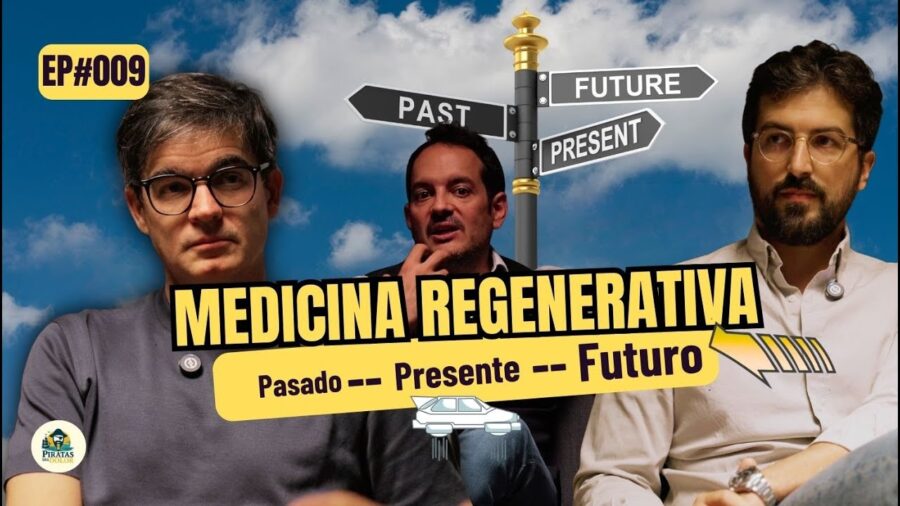
In this special episode of Pirates of Pain, our Medical Director, Dr. Jorge Orduña, inaugurates a “table of wise men” to delve into one of the most promising and, at the same time, complex fields of medicine today: regenerative medicine. Accompanied by Dr. Jordi Recasens and Dr. Guillerme Ferreira, we analyze the paradigm shift from reactive treatments to personalized therapies that use the resources of the patient’s own body.
Regenerative medicine vs. orthobiological medicine: clarifying concepts
They are often used as synonyms, but there are important nuances that our Medical Director, Dr. Jorge Orduña, and his guests clarify from the outset:
-
Regenerative medicine: Strictly speaking, it seeks to repair damaged tissue from a structural point of view. It includes advanced therapies such as mesenchymal cells, tissue engineering and gene therapy.
-
Orthobiological medicine: This is a more clinical and current approach. It uses autologous products (the patient’s own) to biologically modulate inflammation and create a favorable environment for recovery, improving pain without necessarily restoring all the original structure immediately.
Platelet-rich plasma (PRP): the challenge of standardization
PRP is probably the most widespread orthobiological therapy in Spain. However, there is no “single PRP”. Factors such as the concentration of platelets, the presence or absence of leukocytes (white blood cells) and the collection system (open or closed) determine the result.
A fascinating aspect mentioned in the podcast is the patient’s own variability: the platelet concentration can even change depending on whether the blood is drawn in the morning or in the evening. Therefore, the big challenge for the coming years is global protocolization to provide homogeneous and predictable results.
Cytokine-rich sera: anti-inflammatory evolution
Unlike PRP, cytokine-rich serum is an acellular product that stands out for its powerful anti-inflammatory capacity. It is a treatment widely developed in southern Europe (Spain and Italy) and is differentiated by its prior incubation process. While PRP focuses more on repair, these serums are especially useful in conditions where inflammation (such as synovitis in a knee) is the predominant symptom.
Stem cells: between hope and regulation
The debate on stem cells (usually extracted from bone marrow or fat) introduces a further level of complexity. Here the regulations are strict:
-
Non-advanced therapies: Minimal manipulation in the same surgical act.
-
Advanced therapies: They require cultivation and expansion in highly qualified laboratories (GMP), which multiplies costs and regulatory requirements.
Although the potential is enormous, the scientific literature still shows mixed results due to the lack of unified protocols. We are in a key decade to understand how these cells interact with the patient’s tissue and under what conditions they offer their maximum benefit.
Conclusion
Regenerative medicine is not a promise of the future, it is a reality that we are already applying. However, as our Medical Director, Dr. Jorge Orduña, MD, rightly concludes, “Regenerative medicine is not a promise for the future. Dr. Jorge Orduñarequires from us professionals continuous training and a very precise selection of the patient and the biological moment for these treatments to reach their maximum effectiveness.