

Trigeminal Neuralgia
What is
What is the trigeminal nerve?
The trigeminal nerve is the largest cranial nerve in the human body and one of the most important from a functional point of view. Its name refers to its structure, since it is composed of three main branches: the ophthalmic nervethe maxillary maxillary nerve and the mandibular nerve.
This nerve has a mixed function mixedwhich means that it participates in both sensory sensory transmission as well as in the motor innervation. On the one hand, it picks up the sensitivity of almost the entire face, and on the other hand, it activates the muscles in charge of chewing. In addition, it also plays an important role in the control of the muscles that contribute to the ventilation of the middle ear. ventilation of the middle earThis explains why an alteration in the mandibular musculature can influence discomfort or dysfunction at the level of the ear.
Due to its size and complexity, the trigeminal nerve can be involved in multiple clinical conditions affecting the cranial, cervical and mandibular region. cranial, cervical and mandibular region..
What is trigeminal neuralgia?
The trigeminal neuralgia is a neurological disorder characterized by episodes of intense facial severe facial painwhich patients commonly describe as an electric shock sensation. electric shock or sharp stabbing sensation. This pain, which is usually unilateral, originates from the involvement or compression trigeminal nerve, and can significantly impact quality of life.
Also known as tic pain, trigeminal neuralgia is characterized by persistent facial pain with a burning sensation. Generally, the pain is unilateral, that is, it affects only one side of the face, and although in its first manifestations the pain is mild and occasional, if the disorder is not treated, the episodes become more frequent and the pain more intense.
Trigeminal neuralgia is a severe facial pain syndrome, and is the most frequent type of facial pain, with a prevalence of 4 to 13 cases per 100,000 inhabitants. It directly and clearly affects the quality of life of sufferers, who often present depressive syndromes. It usually occurs after the age of 50 years, and is more frequent in women than in men in a ratio of 1.5 to 1.
Although the pain caused by the disorder may be spontaneous and intense, constant and localized, or spasmodic, depending on the case, over time, any movement of the face may trigger a new painful episode.
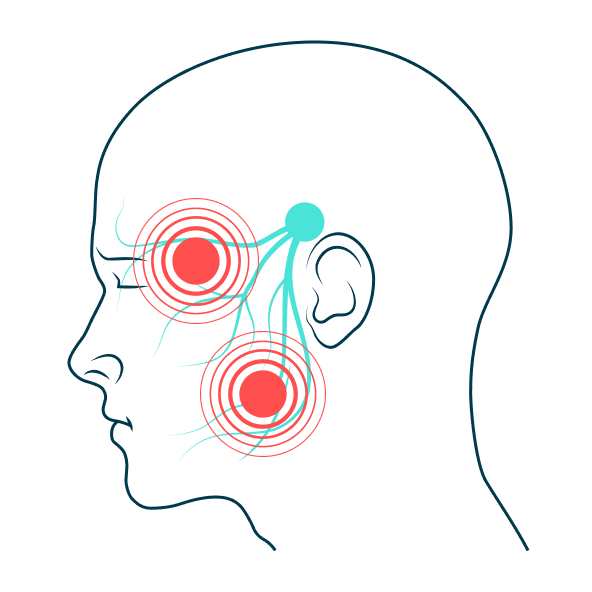
The trigeminal nerve is divided into three branches, each responsible for transmitting sensation to different areas of the face:
- – Ophthalmic branch (V1)(V1): collects the sensitivity of the forehead, the scalp and the eye area.
- – Maxillary branch (V2)transmits sensation of the midface, including cheeks, nose and upper lip.
- – Mandibular branch (V3)provides sensitivity to the jaw, the lower part of the face and also activates the masticatory muscles.
When an alteration occurs in any of these branches, episodes of sudden pain may arise, which in many cases are triggered by stimuli as commonplace as talking, chewing, brushing teeth or even feeling a blast of air on the face.
Causes
The causes of this pain can be the malformation of a vessel, the existence of a tumor that compresses the nerve in its path or diseases such as multiple sclerosis.
It is usually caused by contact between the trigeminal nerve and a blood vessel, which causes pressure on the nerve and its dysfunction.
Among the triggering causes, there are also facial trauma or stroke.
Symptoms
Characteristics of trigeminal neuralgia pain:
- Episodes of intense, stabbing pain in the form of electric shock.
- Areas of pain: cheeks, jaw, teeth, gums, lips, eyes and forehead.
- They may be accompanied by very limiting facial spasms.
- It usually presents on one side of the face (unilateral).
- It can be triggered spontaneously or provoked by common everyday gestures.
- The attacks are transient and last from a few seconds to minutes.
- The pain usually does not occur at night.
The manifestation of this pain occurs after small typical daily acts such as touching the face, smiling, brushing the teeth or shaving. Mild stimulation can trigger this intense pain that usually lasts for seconds but tends to recur many times during the day for the duration of the crisis.


Our customers say


Insurance companies
Ask your MIVI centre for information on the agreements with insurance companies.