
Shoulder Bursitis

What is

One of the most common pathologies at the level of the shoulder joint is the dreaded bursitis.

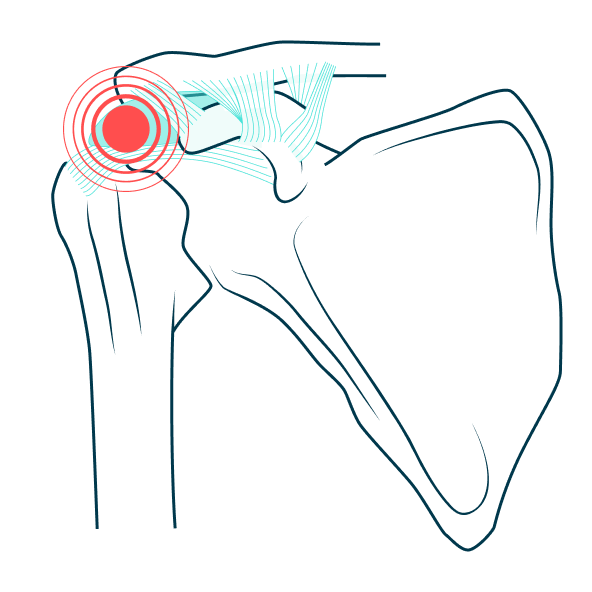
Before delving a little deeper into the injury, we can define the bursa as a structure, which is a kind of small sacs filled with synovial fluid placed strategically between different structures (one fixed and the other mobile or both mobile) in order to avoid excessive friction between them.

The suffix -itis is added when the bursa becomes inflamed by some cause external to it, which generates an increase of fluid formation within it and the increase in volume of the bursa. This growth of the structure can compromise the proper functioning of the sliding of adjacent structures and excessive pressure on the bursa causing pain by receptors in the walls of the bursa.

Types of mocks within the shoulder joint complex:

  • Subdeltoid: below the deltoid muscle.
  • Subacromial: below the acromion (bony roof of the shoulder).
  • Subscapularis: underlying the tendon of the subscapularis muscle.
  • Subcoracoid: below the coracoid process (anterior part of the shoulder near the pectoral muscles).

Bursitis is common in middle age and is more common in women than in men. At younger ages they are more acute pathologies.
Symptoms

The pain usually occurs during daily activities involving shoulder movement.

  • Pain when elevating the upper limb (especially in lateral separation).
  • Decreased mobility due to pain felt.
  • Loss of muscle strength due to inactivity.
  • Pain at night that prevents or cuts off sleep.

Causes and risk factors

  • Direct blows to the shoulder.
  • Wear and tear of the tendons due to repetitive exercises with the hand above the shoulder (throwing sports, cleaning glass, lifting loads).
  • Partial tears of the rotator cuff tendons with inflammation of adjacent structures.
  • Arthrosis of the shoulder or acromioclavicular joint.
  • Misalignment of the shoulders (such as poor posture with anterior retraction of the pectoral musculature).
  • Previous lesions in the shoulder (calcifications type…).

Approach protocol

Diagnosis and assessment

A correct medical evaluation will be necessary by means of a good anamnesis, physical examination and, if necessary, support of imaging tests, focusing especially on detecting which are the factors that have led this pad to become inflamed. We will observe if they are factors purely related to the activities that the patient performs or if there is any anatomical alteration that favors it. The multidisciplinary approach is essential for a comprehensive, personalized and focused on achieving a prolonged relief of pain depending on the phase in which it is.

Complementary tests

Ultrasound and magnetic resonance imaging.

Treatment

  • Interventional treatment: by providing the patient with interventional techniques, we will begin the treatment stage in which we will develop therapies to reduce the inflammation of this pad through the use of regenerative medicine or ultrasound-guided blocks.
  • Physiotherapy: Treatment in the field of physiotherapy for this type of ailment ranges from cryotherapy (cold), manual therapy to relax and stretch associated contractures and shortening, neuromodulation (analgesic currents), postural and motor control correction of the structures of the shoulder complex (readaptation work and Redcord), to EPI (galvanic currents to reduce inflammation).

Here begins your life without pain

Our customers say

Wuilmar Galue
3 days ago
AML L
3 days ago
Muy buenos profesionales , atentos , amables y con calidad humana . Destacar también recepción que reciben con una sonrisa . Las instalaciones limpias . Al día de hoy mi experiencia en esta clínica es excelente .
Excelente atención, con profesionales de primera linea, tanto como el equipo medico, administrativo y del Dr. Algarra
Roser Hurtado
5 days ago
Encantada con la Dra.Natàlia Neira. Empàtica y cercana.Me he sentido comprendida. Muy hábil con la eco grafía, su infiltración ha marcado un antes y un después. Gracias Dra.Neira.
Detlef Neumann
2 weeks ago
Ich wurde sehr gut und kompetent behandelt
Merche
2 weeks ago
Quiero destacar el gran trabajo de Nicolás. Después de años arrastrando molestias por un accidente del que nunca llegué a recuperarme completamente, y tras sufrir otro más reciente que me provocó fuertes dolores lumbares, había pasado por varios terapeutas sin encontrar una solución real. Nicolás fue el primero en identificar el origen de mi problema. Me explicó claramente qué estaba causando el dolor y comenzó a tratarlo de forma específica. Desde entonces estoy notando una mejoría importante y, por primera vez en mucho tiempo, siento que estoy avanzando de verdad. Muy agradecida por su profesionalidad y por haber encontrado la causa de unas molestias que llevaba años arrastrando. Totalmente recomendable.
Antonia Guesoler
2 weeks ago
Muy buen profesional JESUS,la pena es la demora que hay
Buenas tardes, el Doctor Nebreda y su equipo son muy buenos profesionales y el trato es formidable , sobre todo la enfermera Julia, estoy muy contento con sus intervenciones y tratamientos....lo recomiendo a cualquier persona que le haga falta para tratar su dolor, un saludo.
No puedo poner más estrellas. El Dr .Nebreda y todo su equipo son excelentes profesionales. Muchas gracias por vuestro trato

Insurance companies

Ask your MIVI centre for information on the agreements with insurance companies.